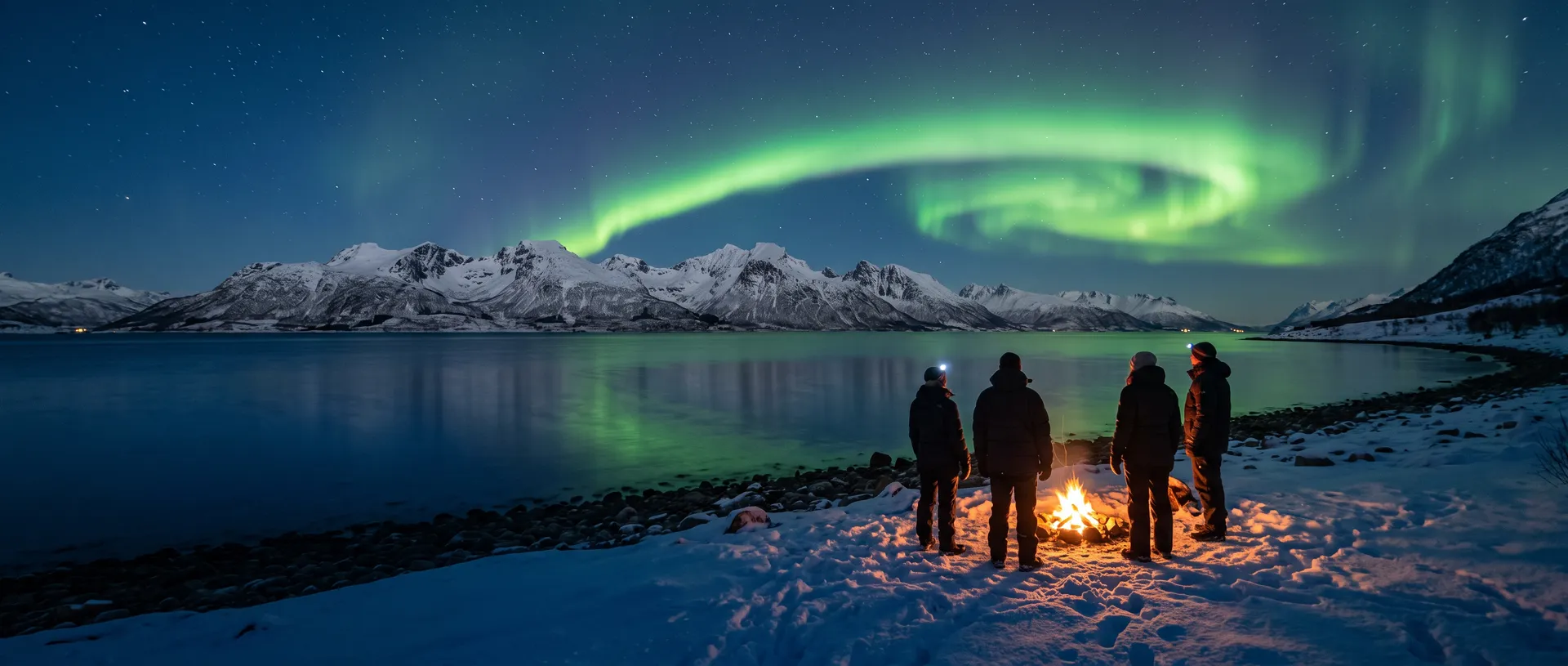
To see the northern lights in Norway, head north of the Arctic Circle between October and March, stay at least four nights and book a tour that goes looking for clear skies. The main obstacle is not the aurora. It is the cloud: in Tromsø, the sky clears on only one winter night in three, according to ten years of readings from the Norwegian Meteorological Institute1. When it does clear, the aurora shows up at least every other time in the region2.
The plan that gives you the best odds:
- Base yourself in Tromsø. Close to half of the country's tours leave from there, and they are the cheapest in the north: €105 to €165 for most of them.
- Go in February if you can. Nights still last almost twelve hours and solar activity is close to its winter peak.
- Stay at least four nights. That gives you roughly a two-in-three chance of a clear night, eight in ten with a week.
- Book your tour for the first evening, by coach or minibus. The guide drives towards the breaks in the cloud, sometimes as far as Finland. If it stays overcast, you still have nights left to try again.
- On the other evenings, check the cloud cover on yr.no and avoid full-moon nights, which dim the aurora.
- Be outside between 10 pm and 2 am, away from city lights.
Our best spots
Where can you see the northern lights in Norway?
The whole north of the country lies under the auroral oval, the ring where the lights are most frequent. You enter it in the afternoon and travel through it during the evening and the night. Between two northern towns, the difference is not the aurora itself. It is the cloud, the choice of tours and their price.
Tromsø: the easiest base
Close to half of Norway's northern lights tours leave from Tromsø, and they are the cheapest in the north. The core of the market runs from €105 to €165, with entry prices around €60.
A tour usually lasts three to seven hours, in the evening and into the night. The guide does not take you to the same spot every evening. They follow the cloud. When the coast is socked in, several operators drive on into Finland or Sweden, which is why one of them tells you to bring your passport or ID card.
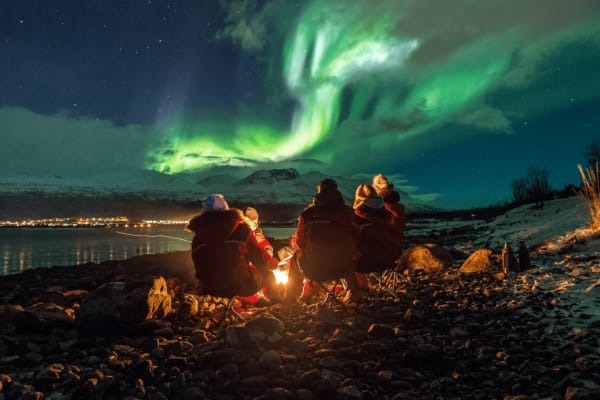
You wait outside, sometimes for a long time, sometimes around a campfire. Often the aurora first appears as a pale glow to the naked eye, which the camera reveals as green. Bring a recent smartphone with a night mode, or a camera on a tripod: it will show you what your eyes cannot see yet.
The city has another advantage for a stay of several nights: you can fill the days with a husky sledding or reindeer sledding trip. See the northern lights tours from Tromsø.
Alta: less choice, higher prices
In Alta, there are fewer tours and they cost noticeably more: €135 to €230 for most of them. Several add another activity to the evening, such as quad biking, horse riding or meeting Arctic animals.
As for the weather, readings at its airport, at the head of the fjord, show a clear sky on 22% of winter nights between 2001 and 2011, against 31% in Tromsø over the same period. They say nothing about the inland plateau.
Choose Alta if you want to combine the aurora with another activity. For a first trip focused on the northern lights, Tromsø gives you more evenings to choose from on a smaller budget. See the northern lights tours from Alta.
Lofoten Islands: the longest season
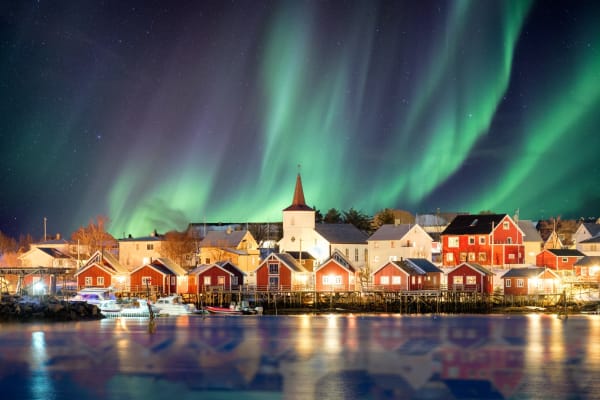
In the Lofoten Islands, most tours from Svolvær cost €120 to €160. Further south than Tromsø, the archipelago keeps its dark nights until 14 April, four days longer. It is the place for travellers who want the aurora and the fjords and beaches in the same trip. It is also the best choice for a trip in early April, when true darkness disappears in Tromsø.
One limit to be aware of: we found no reliable long-term cloud measurements for Lofoten. So we cannot put a figure on your chances there. See the northern lights tours in Lofoten.
Bodø and Svalbard
Bodø has clear skies almost as often as Tromsø (27% of winter nights between 2011 and 2021), but less choice and higher prices, €160 to €230 for most tours. Its season is the longest of the towns in this guide, from 25 August to 16 April. That makes it worth it only for a trip very early or very late in the season. See the tours from Bodø.
Svalbard, at 78° north, is a world of its own. Its weather station has the clearest skies in our records, 34% of nights and up to 42% in March. True darkness lasts 21 hours a day in December.
But the archipelago is so close to the pole that strong solar activity, which pushes the aurora further south3, does not guarantee a better show there. Keep Svalbard for the experience of the polar night. For a first trip focused on the northern lights, Tromsø is simpler and cheaper. See the tours in Svalbard.
If your trip already takes you further afield, a few towns also offer a small number of tours: Hammerfest, Kirkenes, Skjervøy, Børselv and Vesterålen.
When is the best time to see the northern lights in Norway?
The season opens in early September and closes in mid-April, as long as the sun sinks low enough below the horizon at night. In Tromsø, true darkness lasts from 1 September to 10 April. The table below compares, month by month, the length of the night, the weather and solar activity.
| Tromsø | True darkness | Clear nights | Active nights (Kp 3+) |
|---|---|---|---|
| October | 10.7 h | 29% | 39% |
| November | 14.2 h | 30% | 34% |
| December | 16 h | 30% | 31% |
| January | 14.9 h | 29% | 31% |
| February | 11.9 h | 30% | 41% |
| March | 7.6 h | 24% | 42% |
True darkness: sun more than 12 degrees below the horizon (astronomical calculation). Clear nights: at least one reading of 2/8 cloud cover or less, at 7 pm or 1 am (winter time, 19:00 or 01:00), Tromsø city station, winters 2015 to 2025. Active nights: Kp index of at least 3 between 7 pm and 4 am, same winters4.
The table tells you three things.
- The weather barely separates the months: from October to February, one night in three is clear. Only March drops back, to 24%.
- Solar activity rises around the equinoxes. The level at which, according to NOAA, the aurora becomes "brighter and more active" is reached on four nights in ten in February and March, three in ten in December and January.
- Nights shrink fast in March. Less than eight hours of true darkness remain, against sixteen in December.
Your chances of at least one clear night in Tromsø, by length of stay:
| Arriving in | 4-night stay | 7-night stay |
|---|---|---|
| October | 63% | 80% |
| November | 66% | 86% |
| December | 68% | 84% |
| January | 65% | 81% |
| February | 65% | 83% |
| March | 57% | 75% |
Every possible arrival date in the month, checked night by night over ten winters (2015 to 2025).
For a first trip, February has the most going for it. Nights are still long, activity is high and the days are bright enough for a sledding trip. December will appeal more to those who want to experience the polar night, at the cost of slightly lower activity.
Two more settings complete your choice of month, according to NOAA: avoid the full moon, which dims the aurora, and go out between 10 pm and 2 am (22:00 to 02:00), the most favourable hours.
Which northern lights tour should you book?
In Norway, most tours cost €115 to €190, excluding private trips. The difference comes mainly from the format.
| Format | Price of most tours | Best for |
|---|---|---|
| Boat or cruise | €100 to €125 | A warm evening without a long drive |
| Coach | €90 to €140 | The tightest budget |
| Minibus, small group | €140 to €205 | A more mobile chase, often with photos |
| Combined (huskies, reindeer, Sami culture, horses) | €185 to €280 | A full evening, with the aurora as a bonus |
| Private tour | over €700 | A group or a special occasion |
Coach, minibus or boat: what changes
The boat is the cheapest format, but it stays on the fjord. It cannot drive a hundred kilometres to find clear skies. Coaches and minibuses can, and that is their whole point when the coast clouds over.
A minibus costs more than a coach for a simple reason: fewer passengers, more flexibility. When a tour states its group size, it gives anything from 2 to 25 people. Before booking, check what is included as well: just over half of the tours mention photos, more than a third a meal or a hot drink, nearly one in five warm clothing. A mention is not a promise, so check the details.
If the aurora does not show
No tour guarantees an aurora. A few operators in Tromsø do make up for a blank evening.
Jeshua lets you come back for free, under conditions, and Rødne Fjord Cruise gives you a second chance on its catamaran cruise. Polar Adventures offers 30% off a new trip and Spirit in the Sky 50%. As for Arctic GM Experiences, it refunds you if no camera has captured an aurora.
Read the conditions before you book. They change from one operator to the next.
The best-rated operators
Among operators with more than 1,500 reviews, Snow-travels scores 4.9/5, ahead of Arctic Breeze, Northern Horizon and Spirit in the Sky at 4.8/5. The most reviewed, Northern Lights Safari, holds 4.6/5 from more than 8,000 reviews.
For a first time, with three or four nights on site, a minibus with photos and a no-aurora policy gives the best balance. On a tight budget, a coach will do. Book it for your first evening: you will have nights to spare if the sky closes.
Tour or self-drive?
A hire car gives you freedom over your timing. It also leaves you alone with winter roads and with choosing the spot, which guides handle for you by following the weather all evening. If you go on your own, look for a north-facing coast, away from city lights.
Three tools are enough to decide whether to go out:
- For the cloud, yr.no, the service run by the Norwegian Meteorological Institute and the public broadcaster NRK.
- For activity, NOAA's thirty-minute aurora forecast.
- For the moon, any calendar.
Without a car, a tour remains the safest choice for a first trip. From the centre of Tromsø, you can sometimes make out the aurora above the rooftops. The city lights wash much of it out.
Norway, Finland, Sweden or Iceland?
A tour costs a little more in Norway than in its neighbours: around €150, against €140 in Sweden, €130 in Finland and €120 in Iceland.
| Country | Price of most tours |
|---|---|
| Norway | €115 to €190 |
| Sweden | €105 to €170 |
| Finland | €100 to €155 |
| Iceland | €90 to €160 |
Solar activity, for its part, knows no borders. An active night in Norway is just as active in Finnish or Swedish Lapland, at the same latitude.
So you do not choose Norway for the price. You choose it for its fjords and for Tromsø, the town with the most tours, and so the most evenings to try again. If budget matters more than scenery, Finland and Iceland cost €20 to €30 less per tour.
Frequently asked questions
What is the best month to see the northern lights in Norway?
February, for a first trip. Nights still last almost twelve hours in Tromsø and four nights in ten are active, against three in ten in December. From October to February, the share of clear nights stays close to one in three.
Where is the best place to see the northern lights in Norway?
Tromsø, for a first trip: the widest choice of tours, the lowest prices in the north and one clear night in three in winter. Lofoten suits you better if you want to combine the aurora with the scenery, with a season that lasts until mid-April.
How many nights do you need to see the northern lights?
At least four. In Tromsø, four nights give you roughly a two-in-three chance of at least one clear night. A week gives you eight in ten.
How much does a northern lights tour cost in Norway?
€115 to €190 for most tours, a little less in Tromsø, where entry prices start around €60. Private tours cost over €700.
Will winter 2026-2027 be a good season for the northern lights?
The last two winters were very active. Based on our analysis of the Kp index, 55% of nights reached Kp 3 in 2024-2025, then 62% in 2025-2026, the highest level since 2003-2004. The sun reached the maximum of its cycle in October 2024, as it had in November 2001 and April 20145. The winters that followed those two maximums were among the most active in our records. Nothing guarantees, however, that 2026-2027 will follow the same pattern.
Can you see the northern lights in Norway if it is cloudy?
Not through thick cloud. Coach and minibus tours drive towards a break in the cloud, sometimes as far as Finland or Sweden. Boat trips cannot. In Tromsø, a few operators offer a free return, a discount or a refund after an evening without an aurora.
Can you see the colours of the northern lights with the naked eye?
Not always. A faint aurora often looks like a pale glow, which the camera records as green: it is the surprise most travellers talk about. The stronger the activity, the brighter the aurora and the more visible its colours.
Is Norway or Iceland better for the northern lights?
For a first trip, Norway, if your budget allows it: Tromsø offers the most tours, so the most evenings to try again. Iceland is cheaper, around €120 per tour against €150 in Norway. Solar activity is the same on both sides, so the local weather and the rest of your trip will decide.
Sources
- MET Norway (Norwegian Meteorological Institute), cloud cover observations (Frost API), Tromsø, Alta, Bodø and Svalbard stations, winters 2001 to 2025.
- Tromsø Geophysical Observatory (UiT The Arctic University of Norway), "The Northern Lights".
- NOAA Space Weather Prediction Center, "Tips on viewing the aurora".
- GFZ Potsdam, geomagnetic Kp index, 2001 to 2026.
- SIDC, Royal Observatory of Belgium, "Solar cycles min/max" (maximums of cycles 23, 24 and 25).
See all Northern Lights Tours in Norway offers
94 offers →